“33kV” is a system voltage, not a steel-pole or steel-crossarm structural specification. For a comparable quotation, send the approved structure schedule, load basis and drawing revisions, then state steel, geometry, joints, attachments, galvanizing, inspection, marking, packing and delivery requirements. KOVYEL can coordinate a manufacturing-scope quotation and written clarification list; final line design, loads and approval remain with the purchaser’s appointed engineer.
Build the 33kV steel pole and crossarm RFQ as five controlled files.
The most reliable inquiry is a small technical package, not a product name copied into an email. These five files keep engineering decisions, quantities and supplier responsibilities traceable during quotation.
Project data sheet
Identify the nominal voltage, governing project or utility specification, country and site environment, circuit arrangement, conductor and earth-wire system, delivery destination and required Incoterm.
Structure and pole schedule
List every tangent, angle, dead-end, terminal, branch, transformer and special structure code with its quantity, pole height, pole duty and drawing reference.
Pole and crossarm drawings
Provide current revisions showing sections, taper, wall thickness, joint, base or planting interface, attachment positions, crossarm layout, hole diameters, spacing and orientation.
Conductor and insulator schedule
State conductor designation, diameter, mechanical data, circuit configuration, insulator type and mounting, line fittings, earth wire or OPGW, guys and equipment brackets.
Inspection and delivery schedule
Define the inspection and test plan, required certificates, drawing approval, witness or hold points, markings, packing codes, document language and delivery lots.
Supplier compliance schedule
Require the offered value, drawing, document, exception and commercial impact beside every requested field. Blank cells and generic “complies” answers should be clarified before comparison.
Budgetary quotation
Useful while the project basis is still developing. Every assumed pole duty, dimension, steel grade, mass, coating, test and packing basis should be written into the quotation and priced as provisional.
Manufacture-ready quotation
Requires controlled drawings, load inputs, structure quantities, approved deviations, inspection requirements and commercial scope. Production should not start until the agreed approval gate is closed.
33kV steel pole specification fields that belong in the RFQ.
Use one row per pole or structure code. If different duties share a height, keep them on separate lines: equal height does not mean equal strength, steel weight, attachment layout or price.
| Buyer field | What to state | What the supplier should return |
|---|---|---|
| Structure identity | Structure code, function and quantity: tangent, angle range, dead-end, terminal, branch, transformer or special crossing. | Offered code mapped to the purchaser’s code, without combining different duties. |
| System configuration | Single or double circuit, phase arrangement, earth wire or OPGW, conductor and insulator arrangement. | General arrangement drawing showing all relevant attachment elevations and orientation. |
| Design-load basis | Approved load cases, wind and other climatic inputs, conductor tensions, span data, security factors and load application points. | Design calculation or declared pole capacity in the format required by the purchaser. |
| Overall geometry | Finished pole height, planting depth or base-plate interface, ground-line reference, top and bottom dimensions, number of sides and taper. | Dimensional drawing with tolerances and a clear definition of across-flats or across-corners dimensions. |
| Sections and joints | Number and length of sections, transport limit, slip-joint or flange type, minimum overlap and field-assembly method. | Section schedule, overlap tolerance, match marks and assembly instructions. |
| Steel and thickness | Approved material grade or mechanical properties, plate thickness by section, permitted substitutions and traceability requirement. | Offered grade, actual thicknesses, estimated mass and material-certificate commitment. |
| Welding | Applicable fabrication or welding standard, weld categories, acceptance level, procedure and personnel qualification, visual or NDT requirements. | Welding document list and inspection records required for the offered construction. |
| Attachments | Crossarm seats, brackets, climbing or lifting provisions, earthing point, hand holes, cable supports, base details and drain or vent provisions. | Fabrication drawing that identifies every welded or bolted attachment and loose component. |
| Crossarms and braces | Member profile and grade, length, phase spacing, hole pattern, insulator mounting, braces, pole connection, bolts and washers. | Crossarm assembly drawing and complete bill of materials per structure code. |
| Corrosion protection | Governing galvanizing or coating standard and edition, required thickness or mass, sampling, repair acceptance and any coastal or industrial requirement. | Proposed process, certificate and thickness-measurement record; exceptions stated item by item. |
| Marking and packing | Permanent pole mark, structure code, section match mark, package code, lifting and handling marks, nesting and end protection. | Marking drawing, packing method, package count, dimensions, net and gross mass. |
| Documents and timing | Approval drawings, calculations, certificates, inspection records, manuals, language, submission sequence and delivery milestones. | Document register with planned submission dates and commercial exclusions. |
How a buyer should read a 16 m galvanized steel pole drawing.
The values below come from one supplied reference drawing and illustrate the questions a purchaser should ask. They are not a universal KOVYEL model, a standard 33kV design or a value to copy into another project.
Example values—verify before use
A drawing can look complete while still leaving quotation-critical definitions open. Convert every note and dimension into a controlled RFQ field, then ask the engineer to close any ambiguity.
- Assembled length
- 16,000 mm shown.
- Section lengths
- Two sections marked 8,300 mm each.
- Slip-joint overlap
- 600 mm shown; 8,300 + 8,300 − 600 = 16,000 mm.
- Section shape
- Octagonal pole indicated.
- Wall thickness
- 6 mm indicated for both sections.
- Bottom dimension
- 415 mm shown; the buyer should confirm whether this means across flats or across corners.
- Steel note
- Q235B appears in the sample; substitutions require explicit engineering review.
- Surface finish
- Hot-dip galvanizing with ≥86 μm appears in the sample; the governing standard and measurement rules still need confirmation.
- Top closure
- A steel top plate is indicated.
- Crossarm example
- A 4,500 mm L80×6 member and L63×6 support detail appear; hole layout and structure interface must stay drawing-controlled.
- Load note
- “0.35 kN” is shown as wind pressure, but the notation is incomplete for procurement. Confirm the intended unit, load case and application.
Why one country’s 33kV drawing cannot become an “Africa standard”.
Public procurement specifications use different structures, materials and interfaces even at the same nominal voltage. Country and utility terms help a buyer find the right documents; they do not make those documents transferable to another network.
Kenya example
Kenya Power procurement material distinguishes steel-crossarm sections by structure function. Intermediate, angle, section and terminal duties are not treated as one generic cross arm. Use the applicable utility document, drawing number and revision for the actual project.
Nigeria example
Nigeria REA technical standards distinguish crossarm material and arrangement by pole function in their programme. This is project-specific evidence that “33kV crossarm” alone is not a complete purchase description.
Public examples: Kenya Power line specification and Nigeria REA Harmonised Technical Standards. They are cited to demonstrate variation, not as KOVYEL specifications or universal requirements.
“For 33kV” does not define the required pole strength.
The appointed engineer should issue the approved load basis or required pole capacity. The supplier should not infer structural duty only from voltage, pole height or conductor cross-section.
Transverse loads
Wind on conductors, earth wire, insulators, crossarms, equipment and the pole itself; angle loads where the route changes direction.
Longitudinal loads
Conductor tension imbalance, broken-wire or security cases, dead-end loads and terminal loads, as required by the project basis.
Vertical and torsional loads
Component self-weight, conductor weight, maintenance or construction loads, unequal attachment loads and eccentric equipment.
Application heights
Every load must be tied to the correct elevation and direction. A force value without its point of application cannot define the pole moment.
Combinations and factors
State the normal, extreme, construction and security combinations together with the required factors and acceptance criteria.
Foundation interface
Confirm planted length, ground-line point or base plate, bolt template, foundation reaction format and responsibility for geotechnical or civil design.
Reference note: IEC 60826:2017 provides a reliability-based framework for overhead-line loading and strength and notes that country-specific climatic data are needed. It can be applied below 45 kV when the project adopts it, but it does not replace the purchaser’s local design basis or detailed component design.
What to check in a 33kV crossarm drawing and pole-top assembly.
Crossarm length alone is not a manufacturable specification. A quotation-ready drawing connects electrical clearances, insulator mounting and mechanical support to the exact pole interface.
| Drawing check | Buyer question | Risk if omitted |
|---|---|---|
| Structure duty | Is this crossarm for tangent, angle, dead-end, terminal, branch or equipment support? | The wrong member or brace arrangement may be quoted. |
| Phase geometry | Are phase spacing, vertical offsets, orientation and required clearances shown on the approved arrangement? | A catalogue crossarm may not match the insulation layout. |
| Member definition | Are profile, dimensions, material grade, thickness, plates and gussets identified? | Weight, stiffness, galvanizing and price cannot be compared. |
| Hole pattern | Are hole diameter, pitch, edge distance, slot direction and tolerance stated? | Insulators, braces or pole bolts may not fit at site. |
| Insulator interface | Is the mounting type, pin or fitting diameter, hardware stack-up and orientation defined? | The offered insulator and crossarm may be individually correct but incompatible. |
| Pole connection | Are bracket curvature or flats, through-bolts, U-bolts, bands, clamp plates and anti-rotation details shown? | The crossarm may not suit the polygonal pole face or attachment elevation. |
| Fastener set | Are bolt grade, diameter, length, nuts, washers, locking method, coating and quantity per assembly listed? | A “complete set” may arrive with missing or mismatched hardware. |
| Drawing revision | Do the pole drawing, crossarm drawing, structure schedule and BOQ use the same approved revision? | Old hole patterns or superseded quantities can enter production. |
Utility construction libraries contain different drawings for suspension, angle, termination and other 33kV arrangements. This is useful evidence that structure duty controls the assembly; it is not permission to copy another utility’s dimensions. See the Ausgrid NS135 drawing index as one public example.
How to write a hot-dip galvanizing requirement that can be inspected.
“Hot-dip galvanized” describes a process, not a complete acceptance requirement. State the applicable standard and edition, the items covered, thickness or coating-mass criteria, measurement, appearance, repair and documentation.
Purchaser inputs
- Project environment: inland, coastal, industrial, high humidity or other exposure
- Selected standard and edition
- Required local and mean coating criteria, where applicable
- Measurement method, sample size and acceptance rule
- Requirements for vent, drain and sealed hollow details
- Permitted repair method and maximum repair area
- Storage and transport controls against staining or damage
Supplier return
- Base-material thickness used to select the coating criterion
- Galvanizing route for poles, crossarms, plates and fasteners
- Surface inspection and thickness records by lot
- Traceability from inspected items to certificates
- Declared repair, touch-up and handling method
- Any item governed by a separate product-specific requirement
- Photographs or records requested in the inspection plan
Authoritative references: ISO 1461:2022 covers general properties and test methods for batch hot-dip galvanized fabricated iron and steel articles. ISO 14713-1:2017 and ISO 14713-2:2019 provide corrosion-protection and design guidance for zinc coatings and hot-dip galvanizing. The contract must identify which documents actually govern.
Documents to request before shipment—not after a site mismatch.
The document list should match the offered construction and the purchaser’s inspection plan. Requesting every possible certificate creates noise; requesting none removes traceability.
Approved drawings
General arrangement, pole sections and joint, crossarm assembly, base or planting interface, attachments, fasteners, markings and revision history.
Material traceability
Material certificates for the specified steel and critical components, linked to the production lot or traceability method agreed in the RFQ.
Fabrication records
Dimensional inspection, straightness and fit-up checks, weld inspection and any specified NDT, procedure or qualification documents.
Galvanizing records
Certificate or declaration, coating-thickness measurements by agreed sampling, visual acceptance and documented repair where permitted.
Trial assembly
First-article or sample fit-up when required, especially for slip joints, crossarm brackets, hole alignment, base templates and loose hardware kits.
Release and packing
Final inspection release, packing list, pole and section marks, package dimensions, net and gross mass, photographs and document index.
Move the pole and steel-crossarm package from RFQ to shipment release.
Use a gate register with an owner, status and evidence link. This prevents an unresolved assumption from being carried silently into drawings, fabrication or packing.
| Gate | Minimum release condition | Typical owner | Evidence / status |
|---|---|---|---|
| 1 · RFQ issued | Structure codes, quantities, project basis, drawings, required return schedule and commercial destination are identified. | Purchaser / EPC procurement | RFQ revision and attachment register |
| 2 · Clarifications closed | Missing loads, dimensions, material, coating, scope and document questions are answered or retained as priced assumptions. | Purchaser engineer + supplier | Clarification and deviation register |
| 3 · Offer equalized | Required, offered, deviation and evidence columns are complete for every pole and crossarm code. | Procurement + engineering | Signed comparison schedule |
| 4 · Drawings approved | GA and shop drawings show current dimensions, holes, welds, attachments, parts, tolerances and match marks. | Purchaser’s appointed engineer | Approved drawing number, revision and status |
| 5 · ITP agreed | Inspection points, sampling, records, witness or hold points and release authority are defined. | Purchaser QA + supplier QA | Approved ITP and document register |
| 6 · Fabrication released | Materials, approved drawings, procedures and first-article requirements are available; unresolved deviations are not hidden. | Supplier production / QA | Internal release and traceability record |
| 7 · Final inspection closed | Dimensions, fit-up, welds, galvanizing, markings and specified tests are accepted; NCRs are resolved. | Supplier QA / purchaser witness | Inspection dossier and release note |
| 8 · Packing released | Pole sections and crossarm kits match the packing list; surfaces, threads, holes and section identities are protected. | Logistics + QA | Package list, dimensions, mass and photographs |
What a factory-yard steel-pole photo can—and cannot—confirm.
Real images are useful when their evidential boundary is clear. They help buyers inspect visible fabrication and handling features, but they do not replace drawings, certificates, load calculations or lot records.
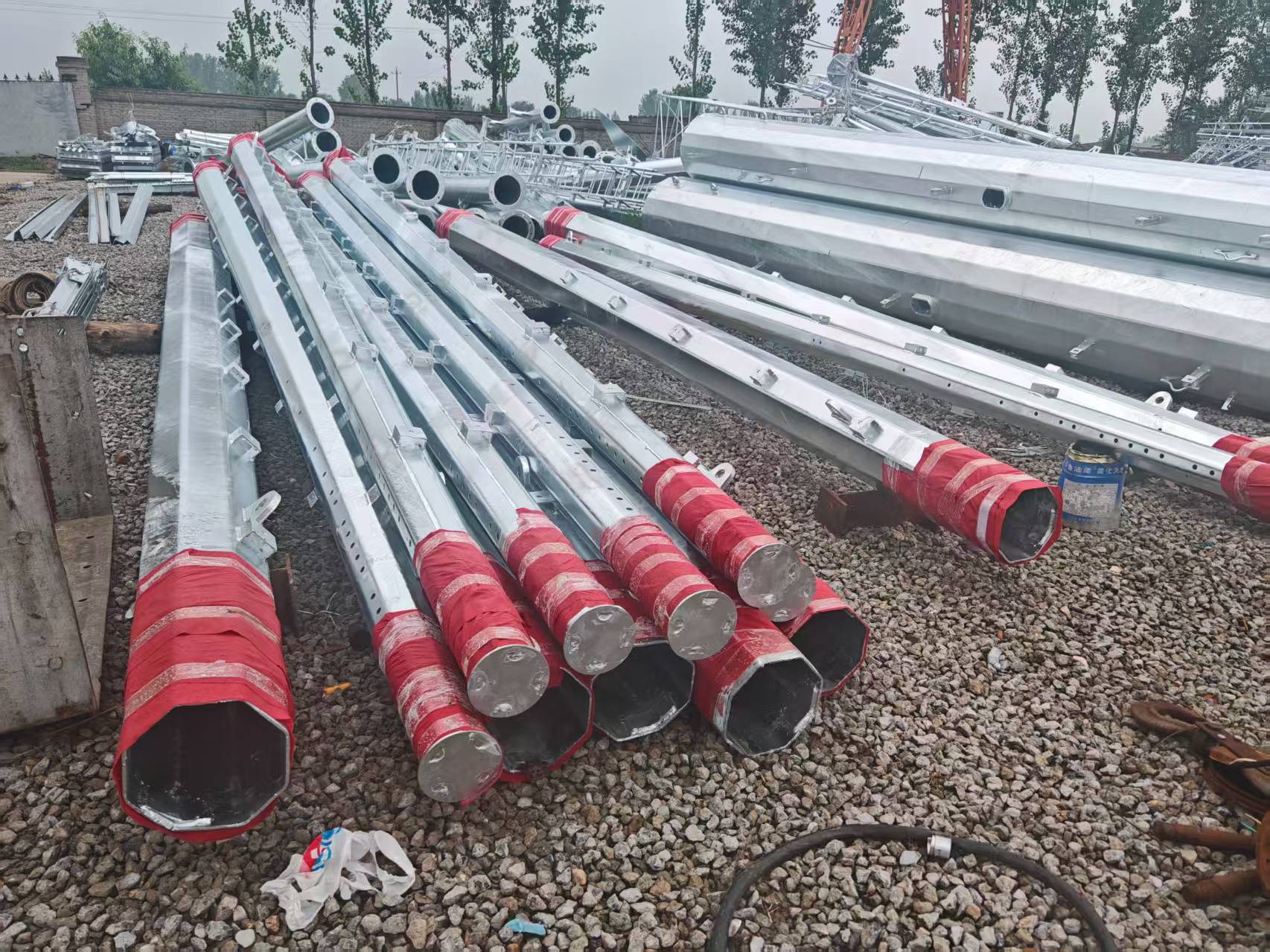
Visible checks
- Polygonal tapered construction and open section ends
- Welded attachments positioned along different pole sections
- Galvanized finish visible on the fabricated surfaces
- Protected section ends before further handling
- Different section sizes that require match marks and a controlled nesting plan
A photo cannot verify steel grade, wall thickness, zinc thickness, weld acceptance, load capacity, drawing revision or country of destination. Ask for the corresponding records.
Steel-pole packing fields that affect delivered cost and site handling.
Long, nested and heavy items behave differently from cartons of line hardware. Packing and shipment data should be part of the quotation, not an assumption added after purchase.
Nesting plan
State which sections can be nested, how galvanized surfaces are separated, the removal sequence and whether loose parts are stored inside pole sections.
End and surface protection
Define end covers, spacers, wrapping, drainage and methods to prevent steel straps or lifting equipment from damaging the coating.
Bundle identity
Use durable structure codes, pole numbers, section match marks and package numbers that remain readable through handling and customs inspection.
Handling data
Provide lifting points or instructions, bundle dimensions, centre-of-gravity information when required, net mass and gross mass.
Container or breakbulk basis
Confirm transport length, loading method, lashing responsibility, container limitations and whether unloading equipment is available at destination.
Commercial basis
Separate product price, tooling if any, inspection cost, export packing, inland transport, freight and Incoterm responsibilities.
How procurement teams should compare 33kV steel pole quotations.
Normalize the technical scope before comparing totals. The cheapest offer is not comparable if it excludes braces, fasteners, documents, galvanizing tests, packing or a stronger structure duty.
| Comparison column | Why it belongs in the commercial comparison | Red flag |
|---|---|---|
| Pole / structure code | Keeps tangent, angle and dead-end duties separate. | One price and one weight for every pole of the same height. |
| Offered design | Records section shape, dimensions, thickness, grade, joint and estimated mass. | Only “as drawing” with no offered drawing or mass. |
| Complete assembly | Shows whether crossarms, braces, bolts, base parts, guys or brackets are included. | “Complete” is used without a component list. |
| Compliance / deviation | Lets engineering review every exception and its price or schedule impact. | Material, thickness or coating changed silently. |
| Documents and inspection | Separates included records, third-party inspection, witness points and optional tests. | Certificates promised only after shipment. |
| Unit, total and tooling | Separates recurring unit price from mould, tooling, prototype or first-article costs. | Tooling reappears on repeat orders without explanation. |
| Lead time | Distinguishes drawing approval, material procurement, production, inspection and dispatch. | One lead time starts from an undefined date. |
| Packing and logistics | Records package count, dimensions, gross mass, freight basis and destination responsibility. | CIF or delivered price without a named port/place and Incoterm version. |
Project buyers and distributors should not send the same inquiry.
The technical core remains drawing-controlled, but the quantity logic, commercial information and call to action should reflect the buyer’s real purchasing model.
For EPC and project procurement
Send the approved structure schedule, current drawings and project specification.
- Quantities by structure code and delivery lot
- Approved load basis and conductor interfaces
- Compliance schedule and clarification log
- Inspection plan and handover document register
- Destination, Incoterm and required milestones
For distributors and importers
Define the applications and repeat-order model instead of using one generic “33kV pole”.
- Target structure families and local utility drawings
- Annual or repeat-order quantities by variant
- MOQ, mixed-load and stocking requirements
- Private label, bundle marks and warehouse handling
- Destination port, replenishment timing and spare hardware kits
Copy-and-paste RFQ template
Replace every bracketed field. Attach the pole schedule and drawings instead of describing geometry only in the email.
Subject: RFQ – 33kV Galvanized Steel Poles and Crossarms – [Project / Country]

1. Buyer type: [EPC / utility procurement / distributor / importer]
2. Nominal voltage and system: [ ]
3. Governing specification and edition: [ ]
4. Site environment: [altitude / coastal or inland / wind and other design inputs]
5. Structure schedule: [attached filename and revision]
6. Pole drawings: [drawing numbers and revisions]
7. Crossarm / pole-top drawings: [drawing numbers and revisions]
8. Structure duties and quantities: [tangent / angle / dead-end / terminal / special]
9. Conductor, earth wire or OPGW data: [designation / diameter / RTS / tensions]
10. Required steel grade and thickness schedule: [ ]
11. Section, joint and foundation interface: [ ]
12. Galvanizing / coating requirement: [standard, edition and acceptance criteria]
13. Inspection and documents: [ITP / certificates / tests / drawings / language]
14. Spare quantities and loose hardware: [ ]
15. Marking and packing: [structure code / section match mark / package code]
16. Destination and Incoterm: [named port or place + Incoterm version]
17. Required delivery date or lots: [ ]
18. Please return: offered specification, unit mass, component scope, deviations,
    unit and total price, tooling, lead time, package count/dimensions/weight,
    document list and quotation validity.
What KOVYEL can coordinate.
KOVYEL supports BOQ normalization and product matching, drawing-based steel-pole and pole-line hardware supply, item-specific document coordination, export packing and shipment coordination after technical and commercial confirmation.
Line design, structural approval, foundations, civil works, installation, site testing, commissioning and grid connection are not included. Final design inputs and technical acceptance remain with the purchaser and its appointed engineer.
Send your structure schedule, pole and steel-crossarm drawings, quantities and destination for a line-by-line quotation review.
Continue your BOQ and drawing review
Use the guide for the actual project voltage and scope. Confirm drawings and interfaces before selecting materials.
Technical Selection Data
| System context | 33kV nominal; voltage alone does not define pole height, strength, wall thickness or crossarm geometry |
|---|---|
| Structure duty | Identify tangent, angle range, dead-end, terminal, branch, transformer or special structure code and quantity |
| Pole geometry | Confirm total and above-ground length, planting or base-plate interface, top and bottom size, taper, sides and tolerances |
| Sections and joints | Confirm section lengths, slip-joint overlap or flange details, match marks and field-assembly method |
| Design-load basis | Provide approved load cases, combinations, factors, directions and application elevations |
| Steel crossarm interface | Confirm duty, profile, grade, length, hole pattern, insulator positions, braces, pole connection and complete fastener set |
| Materials and fabrication | State steel grade, thickness by section, welding and inspection requirements, traceability and permitted substitutions |
| Corrosion protection | State the selected standard and edition, item scope, coating acceptance, sampling, repair and environment-specific requirements |
| Inspection evidence | Define drawings, material certificates, dimensional and weld records, fit-up, galvanizing records and any specified test |
| Delivery control | Confirm markings, bundle and kit identity, protection, package count, dimensions, mass, destination and Incoterm |
- Applicable voltage
- 33kV nominal system context; confirm the project’s highest equipment voltage and approved electrical arrangement. Voltage alone does not define the pole or steel-crossarm structure.
- Material
- Project-specified structural steel for pole sections, steel crossarms, braces, plates and attachments; grade, thickness, substitutions, welding and hot-dip galvanizing must follow the approved purchase documents.
- Standards
- The project or utility specification, approved drawings and purchase schedule control. ISO 1461:2022, ISO 14713, IEC 60826 or other national and international documents apply only when the contract names them; product-specific fastener requirements remain separate.
- Applications
- Procurement, technical submittal, quotation comparison, inspection and export release of drawing-based galvanized steel poles and steel crossarms for 33kV overhead-line structures.
BOQ Information to Confirm
Project and utility specification | drawing numbers and revisions | structure codes, duties and quantities | circuit and conductor interfaces | approved load tree and combinations | pole height, ground line or base interface, section geometry and joints | steel grade and wall thickness | crossarm member and hole pattern | fastener set | galvanizing acceptance | ITP and document register | match marks and packing | destination | Incoterm | delivery lots
Compatible Products & Accessories
Frequently Asked Questions
What files are needed to quote a 33kV steel pole and crossarm package?
Send the structure and pole schedule, current pole and crossarm drawings, approved load basis, conductor and insulator interfaces, project or utility specification, quantities, inspection requirements, destination and Incoterm. Mark missing inputs instead of replacing them with silent assumptions.
Is a 16 m steel pole automatically suitable for a 33kV line?
No. Pole height alone does not prove suitability. The approved structure duty, load cases, clearances, conductor system, ground-line or base interface, section geometry and structural calculation must be confirmed.
Which drawing revision controls steel-pole manufacture?
The purchase documents should identify the approved-for-manufacture drawing number, revision and status. Any conflict with the BOQ, utility specification or supplier shop drawing should be closed in a written clarification or deviation register before production.
How should hot-dip galvanizing be specified?
State the selected standard and edition, which items it covers, thickness or coating-mass acceptance, sampling, appearance, repair and documentation. Do not apply one micrometre value to every steel thickness, fastener and environment without checking the governing requirement.
What should a pole and crossarm inspection plan cover?
Typical points include material traceability, dimensions, straightness, taper, holes and flange alignment, weld inspection, trial fit where required, galvanizing appearance and thickness, markings, final release and packing verification. Tests and sampling must be agreed in the ITP.
How should multi-section poles and crossarm kits be marked and packed?
Use durable pole, structure and section match marks; protect slip-joint surfaces, flanges, threads, holes and galvanized faces; keep each crossarm hardware kit traceable; and record bundle count, dimensions, net and gross mass, lifting information and package numbers.
Technical review: Moyao Liao — KOVYEL Technical Reviewer · Last reviewed